Kawhi Leonard gives the Raptors the star their good team was missing
Toronto went 46-36 and lost a seven-game series to Cleveland, then let Brandon Ingram go and added Kawhi Leonard. Our model ranks the Raptors 6th of 30, at about 48 wins.
4 min read How this story was written
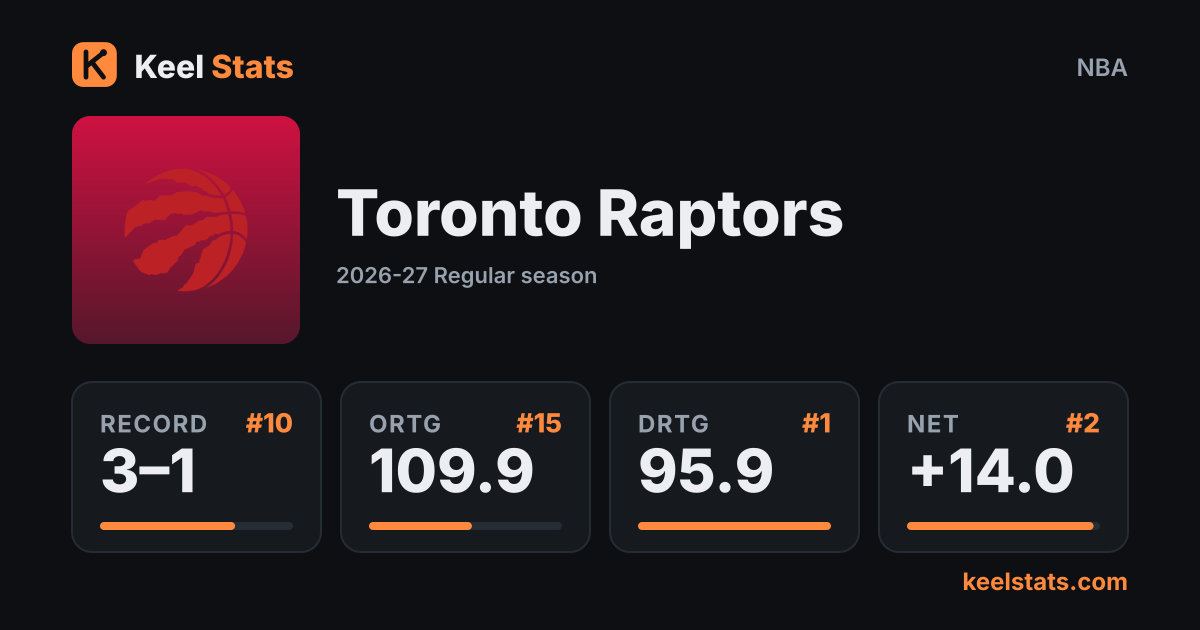
The Toronto Raptors were a good team last season. This summer they went looking for a great player, and they found one. Kawhi Leonard arrives from the LA Clippers, Brandon Ingram goes the other way, and Scottie Barnes finally has a partner who graded even better than he did. The question for 2026-27 is how far a team that was one win from moving on can go with that kind of upgrade.
Last season was solid, with a sting at the end. Toronto went 46-36, finished 5th in the East and outscored opponents by 2.8 points per 100 possessions, a real winning team rather than a lucky one. The playoffs lasted one series: the Cleveland Cavaliers took it four games to three. Close enough to hurt, and close enough to believe one star could change the ending.
Who was actually on the floor for Toronto? Not always the same people. Jakob Poeltl was out for 36 of the team's 82 games, RJ Barrett for 25 and Collin Murray-Boyles for 24. In the 68 games with Scottie Barnes, Immanuel Quickley and Jamal Shead all on the floor, the Raptors went 40-28; in the other 14, with one of them out, 6-8.
Who left, who came
Leonard is the headline, and the numbers back it up. He averaged 27.9 points, 6.4 rebounds and 3.6 assists in 32.2 minutes over 65 games, and our impact rating, the points per 100 possessions a player adds over an average one, had him at 7.1. Nobody on last season's Raptors came close. If his game travels, Toronto has a different ceiling.
Ingram is the price in minutes, not in quality. He played 33.8 a night over 77 games, more than anyone on the roster, but graded slightly below average (-0.44). Handing those minutes to Leonard is about as clear an upgrade as the numbers allow. The loss that could sting is Sandro Mamukelashvili, now with the Los Angeles Lakers, who played 80 games at 21.9 minutes and graded well above average (1.72).
Gradey Dick followed Ingram to the Clippers after 76 games (-0.47), Ochai Agbaji left for the New York Knicks (-1.69) and AJ Lawson is gone. The other newcomers are depth: Kyle Anderson from the Utah Jazz, Malachi Smith from the Brooklyn Nets, Trey Jemison from the Knicks and Andre Jackson Jr. from the Milwaukee Bucks. In all, 66% of last season's minutes return.
Barnes and Leonard
Barnes is still the Raptors' constant. He played 80 games at 33.5 minutes with 18.1 points, 7.5 rebounds and 5.9 assists, and his 3.43 led last season's team. He does a bit of everything, which is exactly what a scorer like Leonard needs next to him. For the first time, Barnes does not have to be the whole plan.
The supporting cast is better than its reputation. Immanuel Quickley added 16.4 points and 5.9 assists in 31.9 minutes with a 2.44, and RJ Barrett scored 19.3 points in 30.3 minutes over 57 games with a 2.26. Leonard, Barnes, Quickley and Barrett all graded clearly above average, and that is a lot of good players to put on the floor at once.
The bench has answers
Jamal Shead is the quiet hero. He played all 82 games at 22.5 minutes, handed out 5.4 assists against just 6.6 points and graded 1.39: a backup guard who makes lineups better without needing shots. Teams that go deep in the spring usually have one of those.
Collin Murray-Boyles is the other one to watch. In 21.9 minutes over 57 games he put up 8.5 points and 5 rebounds and graded 1.08, comfortably above average. With Mamukelashvili gone, more frontcourt minutes could be his, and he has earned the look.
The worries
The center spot is thinner than it looks. Jakob Poeltl gave Toronto 10.7 points and 7 rebounds in 25 minutes, but he played only 46 games, and his 0.98 was solid rather than special. Without Mamukelashvili, there is less cover if he misses as many games again.
Ja'Kobe Walter played real minutes, 20.4 a night, and graded right at average (0.02). The new depth pieces do not raise the floor either: Anderson (-0.01) and Smith (-0.1) graded at or just below average, and Jackson came in at -2.4.
Then there is the injury report, long for October. Anderson, Chucky Hepburn, Jamison Battle and Alijah Martin are listed as questionable, and so are two of the three rookies, Allen Graves and Nate Bittle; Jaden Bradley is the third. None of them is central, but a team leaning on two stars needs its depth healthy.
Bottom line
Our roster model ranks Toronto 6th of 30 and projects about 48 wins, a small step up from 46-36. That is a judgment on paper, built on last season, and Leonard is the biggest reason for it. If he plays something like his 65 games again and Barnes keeps growing, the Raptors can beat it. If Leonard misses real time, the projection rests on a team that already found its limit against Cleveland.
The first look comes at home on Wednesday, October 21, at 7:30 PM ET, against the Chicago Bulls.
Also in this story





More on the Toronto Raptors
Share this story
Keel Stats every day
The day's numbers as they come out: follow Keel Stats.
From Keel Stats data; every number is checked against our data before publishing.
Comments
Keep it about basketball and football, and keep it civil.
Sign in to join the discussion.
Sign in to Keel Stats
New here? Your first day of Pro is free, no card.
Loading comments…